
Many new plant managers assume that converting leftover baked goods into high-margin snacks—like croutons or rusks—only requires a simple slicer and an oven. As mechanical engineers who have commissioned hundreds of bakery lines globally, we can tell you definitively: this is a costly myth.
Pretzel dough, fermented bread, and steamed buns possess entirely different physical structures, starch matrixes, and moisture retention rates. Forcing them through a “one-size-fits-all” production line results in excessive crumb waste (scrap), uneven flavoring, and inconsistent crunch.
To achieve maximum ROI and upcycle basic staples into premium snacks with a 6-12 month shelf life, you need targeted thermal processing and precision cutting. Here is the engineering breakdown of how we design distinct lines for Pretzel Croutons(Alkaline water bread cube), Rusks, and Dried Steamed Bun Slices.
The Shared Secret Weapon: Ultrasonic Slicing Technology
Before discussing the differences in baking curves, we must address the most common bottleneck in any bread snack line: Slicing.
Traditional guillotine or rotary blades tend to crush airy bread structures, causing the dough to stick to the blade and generating up to 10-15% crumb waste. To eliminate this, New Neat equips our high-end snack lines with Ultrasonic Slicing and Dicing Machines.
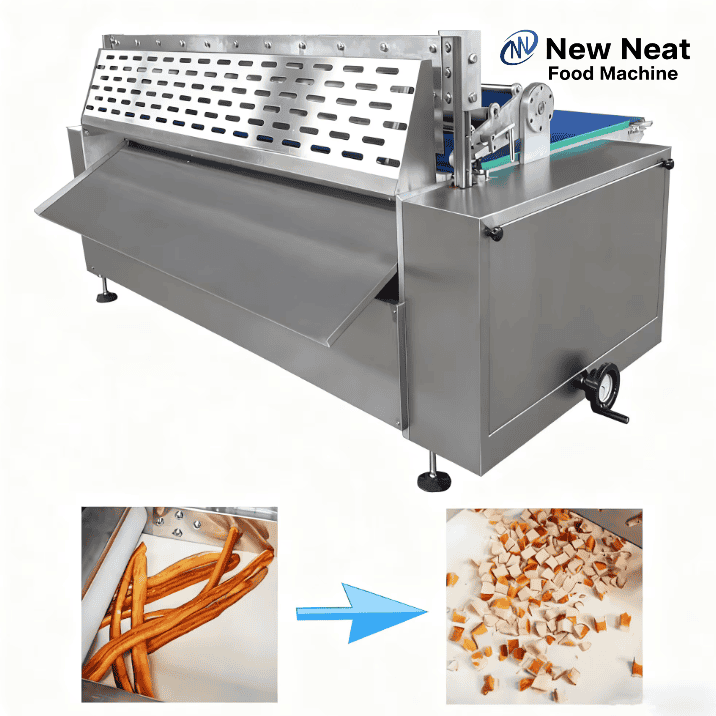
By utilizing high-frequency micro-vibrations, the titanium ultrasonic blades slice through the product with near-zero friction.
- The Result: Razor-sharp edges, perfectly uniform 10x10mm cubes, and zero sticking.
- Versatility: Controlled by a Siemens PLC system, operators can easily switch cutting profiles. The exact same ultrasonic unit that dices dense steamed buns can be reprogrammed to slice delicate, soft pastries like Tiramisu without deformation. Check the video in our [ pretzel crouton production line ].
3 Distinct Thermal Processing Routes
Once sliced, the thermodynamic requirements for these three products diverge completely.
Route A: Pretzel Croutons (Alkaline Dough)
Pretzel croutons require a highly specific dual-baking process to manage their alkaline exterior and dense interior.
- First Bake (Crust Formation): The alkaline dough passes through an electric or gas-fired Hot Air Convection Belt Oven. The high-velocity hot air ensures rapid heat distribution, setting the pretzel’s signature brown crust.
- Dicing: The cooled pretzel logs are diced via ultrasonic cutters.
- Second Bake (Dehydration): Because pretzel cubes are dense, they enter a Multi-tier Tunnel Oven. The multi-tier design maximizes the baking time within a compact footprint, allowing for gentle, prolonged dehydration to bring the core moisture content below 4% without scorching the exterior.
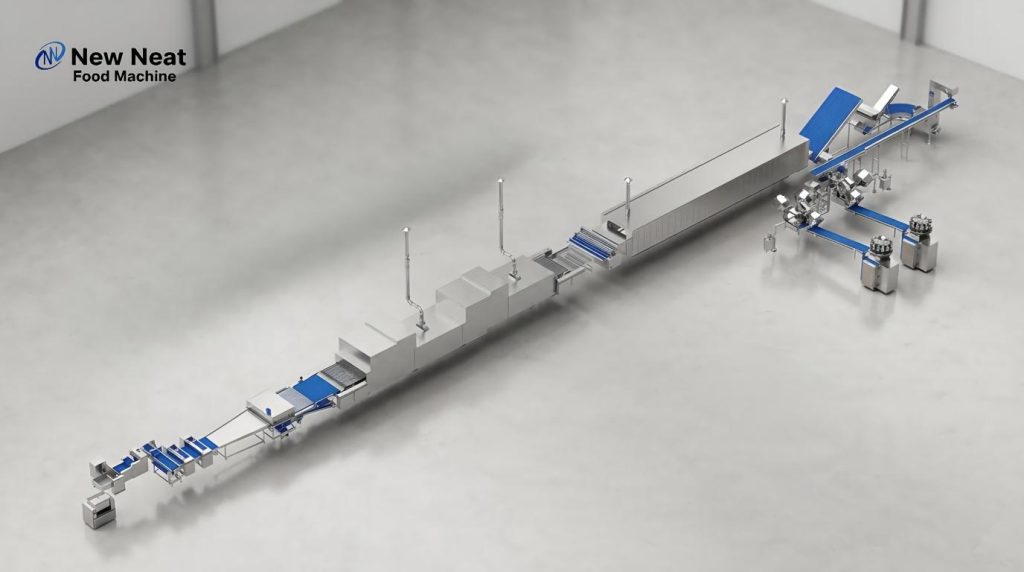
Route B: Traditional Rusks & Bread Bites
Unlike standard bread loaves, our industrial rusk processing is designed for continuous, high-speed efficiency with intense flavor integration.
- Slicing & Arranging: Bread is sliced and fed into an automated arranging and aligning (panning) system.
- Coating & Syruping: Slices pass under a precise syrup/flavoring curtain.
- First Bake (Flavor Setting): The syruped slices immediately enter a Single-layer Tunnel Oven. This crucial step triggers the Maillard reaction, caramelizing the coating and setting the structure.
- Second Bake (The Crunch): Following the first bake and short cooling, the product moves into a second Single-layer Tunnel Oven (Gas/Electric). This dual-tunnel continuous approach guarantees a consistent baking curve, resulting in the perfect golden crunch. [ Rust and Bread Chips Production Line ]
Route C: Dried Steamed Bun Slices (Oriental Mopian)
A highly profitable snack in the Asian market, steamed bun slices bypass traditional baking in the first phase.
- Proofing & Steaming: The raw dough must be fully gelatinized using a Continuous Steaming Tunnel rather than dry heat.
- Cooling (Starch Retrogradation): The steamed buns must be rigorously cooled on sanitary SUS304 cooling conveyors. This forces the starch to retrograde, firming up the structure so it can be sliced cleanly.
- Slicing & Roasting: After ultrasonic slicing, the slices enter a tunnel oven for roasting and final oil-spraying/flavoring.
Quick Reference: Snack Line Configuration Matrix
| Product Type | Initial Processing | Cutting Technology | First Bake | Second Bake |
|---|---|---|---|---|
| Pretzel Croutons | Alkaline dipping | Ultrasonic Dicing | Hot Air Convection Tunnel Oven | Multi-tier Tunnel Oven |
| Rusks / Bread Chips | Slicing & Syruping | Ultrasonic Slicing | Single-layer Tunnel Oven | Single-layer Tunnel Oven |
| Steamed Bun Slices | Proofing | Ultrasonic Slicing | Continuous Steaming Tunnel | Single-layer Roasting Oven |
Flexible Integration: Turnkey or Backend Add-on?
At New Neat, our modular engineering design caters to two distinct business models:
- For Green-field Projects: We provide Full Turnkey Solutions, complete from automated flour dosing and dough mixing all the way to flow-wrapping, fully compliant with CE and HACCP standards.
- For Existing Bakeries: If you already produce bread or steamed buns and want to upcycle surplus capacity into high-margin snacks, you don’t need to rebuild your factory. You can integrate our Backend Add-on Systems—specifically the Ultrasonic Slicer, Syruping station, and Secondary Baking Ovens—directly at the end of your current cooling line.
Stop letting raw material waste and inefficient processing eat into your margins. [ Contact our engineering team today ] to discuss a customized slicing and dehydration system tailored to your specific dough characteristics.