Written by: Engineer Zhang, Chief Mechanical Engineer at New Neat Machine. With over 15 years of experience commissioning industrial bakery lines across 20+ countries.
If you are drafting the procurement specifications for a new biscuit production line today, you are making a decision that will dictate your factory’s profitability until at least 2040.
For food manufacturers in emerging markets—from Southeast Asia and the Middle East to Africa and South America—the operational landscape is undergoing severe structural shifts. The real challenge on the factory floor is no longer just securing orders. It is the critical shortage of skilled veteran mechanics and the relentless market demand for a high-mix, multi-product portfolio.
Approving a quotation for equipment built on 2015 engineering standards is a massive financial risk. A machine that relies on manual tweaking and requires hours of downtime for product changeovers is obsolete before it even leaves the shipping container.
As we look toward 2026, industrial bakery equipment must transition from “heavy iron” to “smart, adaptable tools.” If you are a Chief Engineer or Factory Director reviewing a quote, here are the four non-negotiable technical specifications you must mandate from your machinery supplier.
Specification #1: The End of “Manual Tweaking” (PLC & Automation)
Historically, keeping a biscuit line running smoothly relied entirely on the “old master mechanic.” If a canvas forming web started to drift due to uneven dough sheet weight or humidity changes, a veteran operator had to run over with a wrench, manually adjust the tensioning rollers, and hope they didn’t over-tighten it.
When that operator retires or takes a sick day, a minor misalignment can shred a $1,000 canvas belt in a matter of hours, halting production completely.
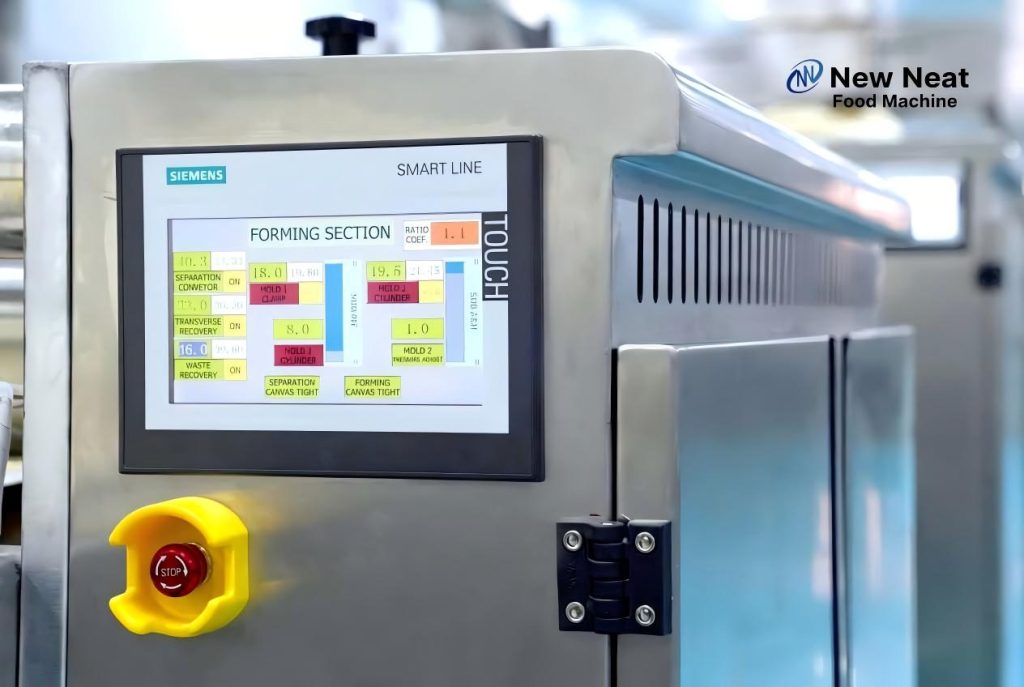
The 2026 Standard: You must specify a highly automated PLC architecture—using globally supported platforms like Siemens—that allows the machine to monitor and adjust itself.
Mandate Automatic Canvas Tensioning and Auto-Tracking. Modern forming lines must utilize pneumatic or servo-actuated cylinders linked to ultrasonic edge-detection sensors (which aren’t blinded by flour dust like cheap optical sensors). When the belt drifts by a millimeter, the system automatically adjusts the roller angle to correct the tracking instantly, without human intervention.
The ROI: You eliminate the reliance on manual skill, drastically extend the lifespan of expensive consumables, and permanently reduce your operating expenditure (OpEx).
Siemens PLC touchscreen control panel for industrial biscuit line
Specification #2: Hyper-Flexibility (The 10-Second Changeover)
Consumers no longer buy the same single type of biscuit year-round. Supermarkets demand variety. Factories must have the agility to run Soda Crackers (hard dough) on a Monday and Chocolate Biscuit (soft dough) on a Tuesday.
On legacy equipment, changing molds or cutting rollers requires heavy lifting, mechanical disassembly, and hours of dead production time. Traditional bronze cutting rolls can weigh over 100kg, requiring a ceiling hoist, multiple technicians, and hours of hazardous manual labor to swap. In 2026, mastering SMED (Single-Minute Exchange of Die) principles for changeovers is a critical KPI for factory profitability.
The 2026 Standard: Demand mechanical designs that treat changeovers as a Formula 1 pit stop. Look for these specific features:
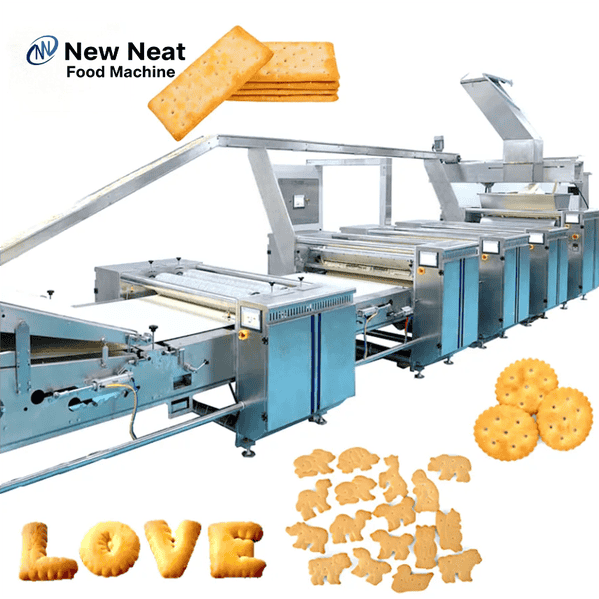
The Dual-Roll Cutting System: For hard biscuit lines, specify a dual-roll cutter. This allows you to install two different biscuit shapes on the machine simultaneously. Switching from a round cracker to a square cracker takes under 10 seconds via the control panel. The dual-roll system eliminates the heavy-lifting hazard entirely.
Tool-less Changeovers: For rotary moulders and cutters, mandate quick-release mechanisms. Operators should be able to slide out a die roll and insert a new one in minutes without using a single wrench.
One-Click Recipe Memory: Physical changeovers are useless if the operator spends an hour manually adjusting belt speeds and roller pressures. Your HMI must feature digital recipe storage. The operator selects the product on the touchscreen, and the PLC automatically sets the exact gauge roll gaps, cutter pressures, and oven band speeds via cascading servo controls.
New Neat automatic hard biscuit machine with Dual-Roll Cutting System
Specification #3: Pragmatic Energy Efficiency
In Europe, machinery is often burdened with highly complex, ultra-expensive exhaust heat recovery systems to meet aggressive carbon regulations. However, for manufacturers in South America, Africa, or the Middle East facing fluctuating natural gas and electricity costs, over-engineering is not the answer. You need pragmatic, bulletproof efficiency.
The 2026 Standard: Do not pay for complex eco-fads that your local technicians cannot maintain. Instead, force your supplier to invest in the fundamental thermodynamics of the Tunnel Oven.
Maximum Thermal Mass Insulation: Scrutinize the oven’s cross-section drawings. Specify high-density rock wool insulation (minimum 250mm to 300mm thickness.) on the top, bottom, and side panels(Our tunnel oven equipped with a 300mm insulation). Keeping the heat inside the baking chamber is the cheapest, most effective way to lower your gas bill and prevent factory overheating.
Proportional Burner Precision: Mandate high-tier proportional burners (such as Weishaupt or Riello). The ability to modulate the flame dynamically to maintain a precise baking curve prevents the outer edges of the biscuit from burning while the center remains raw. Precision heat application drastically reduces your daily scrap rate.
Specification #4: Accessible Sanitary Design
Global food safety standards (like HACCP, FDA, and ISO 22000) are becoming the baseline for supplying large retail chains. While fully automated Clean-In-Place (CIP) systems are excellent, they add massive CapEx and plumbing complexity that is often impractical.
The alternative is intelligent, mechanical design that makes manual wash-downs fast and foolproof.
The 2026 Standard: Sanitary design in 2026 means Accessibility and Eliminating Contamination Points. If an operator cannot see or reach a corner easily, they will not clean it. Over a weekend, trapped dough ferments, creating a severe biological hazard.
Direct-Drive over Chain-Drive: Direct‑drive gear motor system is superior to traditional chain drive. Conventional chain drives suffer from chain stretching, slackness and risk of breakage. They require frequent lubrication, and grease attracts airborne flour dust, creating critical hygiene risks. For bakery & biscuit plants, direct‑drive gear‑motor with IP65 protection is strongly recommended. IP69K is special for high‑pressure hot‑water CIP washing zones and requires special custom‑built units. Our machines adopt Supror helical gear‑motor (IP65 rated for gearbox housing, mating motor IP65).
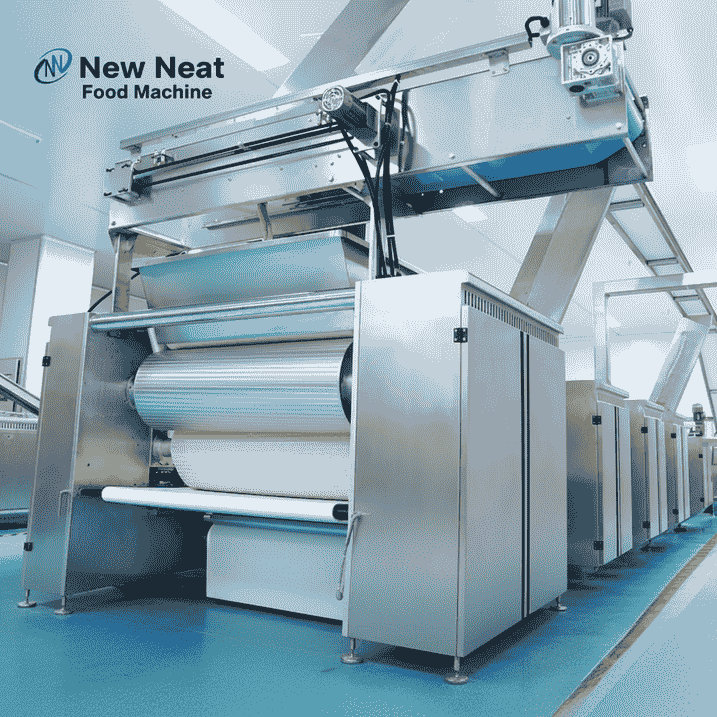
Open-Frame Construction: Reject quotes for machines with enclosed, box-like steel bases. Specify open-frame architecture built from SUS304 stainless steel with high ground clearance, allowing factory hoses and brooms to pass easily underneath.
Quick-Detach Scrap Returns: The scrap web return conveyor on a hard biscuit line is notoriously difficult to clean. Mandate a design where the scrap hoppers and belts can be flipped open or quickly detached. Operators must be able to clear residual dough during a 15-minute shift change.
New Neat automatic hard biscuit machine
The Verdict: Future-Proofing Your Investment
As the industrial baking sector evolves, the definition of a “good machine” has changed. It is no longer just about heavy steel and motor horsepower; it is about intelligent PLC controls, extreme mechanical flexibility, and designs that protect your profit margins from human error.
If a machinery quote looks incredibly cheap, look under the hood. You are likely being sold 2010 technology. The upfront capital you “save” today will be paid back tenfold in wasted canvas belts, delayed changeovers, and high dough rejection rates over the next decade.
Is your upcoming CapEx investment ready for 2026? Don’t finalize your equipment specifications in the dark. Contact the engineering team at New Neat Machine for a [technical consultation]. We can audit your production requirements, review your factory floor plan, and help you configure a turnkey line that ensures total market dominance for years to come.