
For entrepreneurs looking to enter the food manufacturing sector, one question stands above the rest: Is the biscuit business profitable?
The short answer is yes. However, success in this industry is not just about baking a tasty treat; it is about volume, efficiency, and technology. According to recent market reports, the global biscuit market is increasing from $127.99 billion in 2024 to an estimated $134 billion in 2025, growing at a steady annual rate (CAGR) of roughly 4.7%.
Here is a detailed breakdown of why this industry remains a high-profit venture and how the right production line determines your margins.
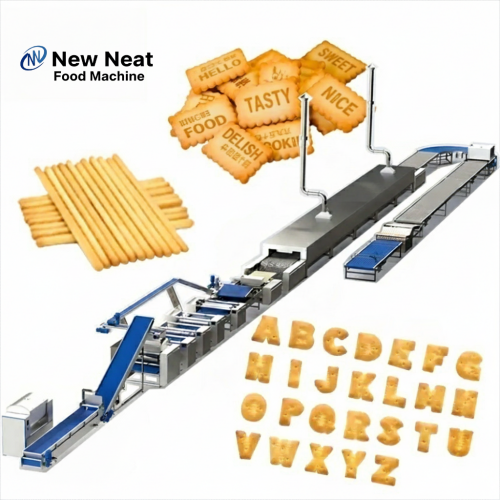
1. High Demand & Recession Resistance
Biscuits are a staple food product. Unlike luxury goods, biscuit consumption remains stable even during economic downturns. Whether it is a low-cost glucose biscuit for energy or a premium butter cookie for gifting, the demand is constant.
- Market Insight: The “Sweet Biscuit” segment specifically is projected to grow significantly through 2030. This ensures a hungry market for your output from day one.
While the market is booming, many newcomers are concerned about the initial biscuit manufacturing plant cost. It’s important to understand that the setup cost depends heavily on your target capacity and automation level.
2. The Role of Automation in Profit Margins
The primary differentiator between a bakery with low margins and a factory with high profits is automation. Manual production involves high labor costs and inconsistent quality. In contrast, an Automatic Biscuit Production Line dramatically lowers the “cost per unit.”
- Consistency: Automated mixers and moulders ensure every biscuit weighs exactly the same, eliminating raw material waste.
- Speed: A high-speed tunnel oven can produce thousands of kilograms per hour, allowing you to scale up without increasing headcount.
When comparing commercial biscuit making machine price, don’t just look at the upfront investment. High-efficiency machines reduce long-term operational expenses through energy savings and lower waste.
| Factor | ⚙️ Manual / Semi-Auto | 🤖 Automatic Line |
|---|---|---|
| 👷 Labor | 20–35 workers/shift High labor & management cost | 6–10 workers/shift Operators, QC & maintenance only |
| 🎯 Consistency | Defect rate 3–8% Quality varies by worker skill | Defect rate <1% Weight deviation ±0.5g via PLC |
| ⚡ Energy | Traditional batch ovens High heat loss, no zone control | Zoned Tunnel Ovens 15–30% energy savings |
| 🧼 Hygiene | High human contact Hard to pass FDA/HACCP audits | 304 Stainless Steel GMP / HACCP / BRC compliant |
| 💰 ROI | Payback >36 months High cumulative maintenance cost | Payback 18–24 months Lower lifetime operating cost |
| 📦 Capacity | 100–200 kg/h Limited by manual bottlenecks | 300–1,000 kg/h Supports 24/7 operation |
| 🔄 Changeover | 2–4 hrs manual mold change Needs experienced technicians | Under 30 min via PLC Supports multiple SKUs |
* Based on international mid-to-high level factory benchmarks. Actual results may vary by scale and region.
Want a detailed profit estimate for your local market? Contact New Neat Machine for a free consultation.
3. Energy Efficiency = Higher Net Profit
In manufacturing, your fuel bill is often your biggest expense after raw materials. This is where New Neat Machine provides a competitive edge. Older ovens waste heat, eating into your profit margins. Our modern Tunnel Ovens are engineered with advanced insulation and energy-recovery systems.
- The Math: If you save 15% on gas or electricity compared to a competitor using outdated equipment, that 15% goes directly to your net profit.
4. Product Versatility
A profitable factory does not just make one thing. Trends change—one year “Digestive” biscuits are popular, the next year it is “Thin Crackers.” Investing in versatile equipment, such as a line that includes both a Rotary Moulder (for soft cookies) and a Laminator/Cutter (for hard crackers), allows you to pivot quickly to meet market trends without buying a whole new machinery set.
Conclusion: The Machinery Makes the Margin
The biscuit business is highly profitable for those who treat it as a precision operation. The market is growing, but the competition is fierce. To secure your slice of the $134 billion market, you need machinery that guarantees low waste, high energy efficiency, and continuous operation.
Optimizing your floor plan can reduce internal logistics costs by up to 20%.
🚀 Free Service:Factory Layout Design
Planning your biscuit production line? Don’t guess the space. Our engineers will provide a Free Layout Design based on your factory dimensions.
*Personalized consultation based on your local market demand.