
Search
Search
Stop Giving Away Profit: Mastering Weight Control in Your Biscuit Production Line
By New Neat New Energy Technology | Production Efficiency Experts
In the biscuit manufacturing business, there is a silent profit killer that often goes unnoticed: “The Giveaway.”
Factory managers often focus on speed—how many tons per day can we produce? But wise owners focus on yield—how much of that tonnage is actually paid for? If your standard biscuit weight is 10g, but your line runs at an average of 10.5g to be “safe,” you are essentially giving away 5% of your raw materials to the customer for free.
In an era of rising flour, sugar, and oil prices, you cannot afford to be charitable. Here is how mastering weight control on your Biscuit Production Line stops the bleeding and secures your margins.
The Math of “Micro-Losses”
Why worry about half a gram? Let’s look at the math used by high-efficiency factories.
Imagine a line running at 1,000 kg per hour.
- Target Weight: 10g per biscuit.
- Actual Average: 10.2g (just 2% overweight).
- The Loss: That is 20kg of dough given away every hour.
- The Annual Impact: In a 20-hour production day, that is 400kg of ingredients wasted. Over a year (300 days), you have given away 120 tons of raw material.
That is not just crumbs; that is the equivalent of hundreds of thousands of dollars significantly affecting your annual report.
Where Does Weight Variation Happen?
Controlling weight isn’t just about the cutter; it starts at the beginning of the line.
1. Dough Consistency (The Mixer)
If your dough density varies between batches, your volume-based forming machines will fail.
- The Fix: Modern Dough Mixers with automated water dosing and timer controls ensure that Batch #1 has the exact same specific gravity as Batch #50.
2. The Forming Stage (The Critical Point)
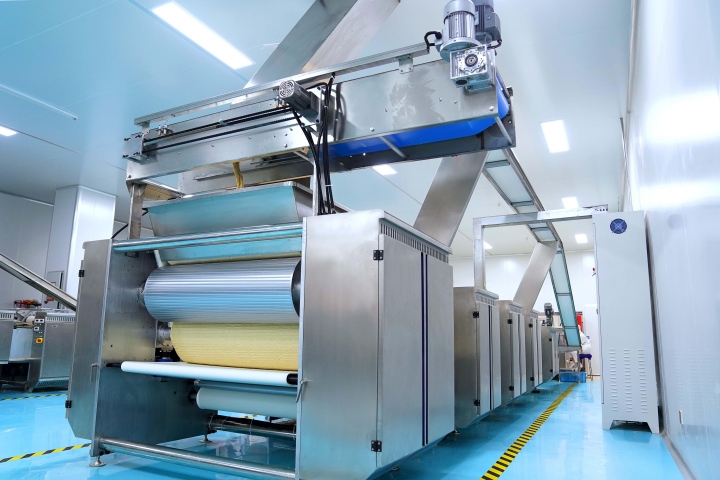
This is where the battle for profit is won or lost. Older machinery relies on mechanical gears that wear down, causing “drift” in weight over time.
- Hard Biscuits: In a Laminator and Cutting line, if the gauge rolls aren’t precise, the dough sheet thickness varies. A variation of 0.1mm in sheet thickness translates to huge weight swings.
- Soft Biscuits: In a Rotary Moulder, pressure variances across the roller die can make biscuits on the left side of the belt heavier than those on the right.
At New Neat Machine, our forming equipment utilizes Servo-Driven Motors. Unlike chains and gears, digital servos do not slip. They maintain precise speed ratios between rolls to ensure uniform weight, row after row.
The Downstream Nightmare: Packaging Jams
Weight control isn’t just about ingredients; it’s about packaging efficiency.
Most modern Flow Wrappers are designed for tight tolerances. If a biscuit is overweight, it is often slightly oversized in dimension (spread).
- The Consequence: Oversized biscuits get crushed in the packaging tube or jam the feeder.
- The Cost: Machine downtime. Every minute your packaging line stops to clear a jam, your oven keeps running, leading to increased waste/scrap.
The Solution: Intelligent Production Lines
You cannot fix what you cannot measure. The solution to “The Giveaway” is upgrading to an intelligent Biscuit Production Line that prioritizes precision engineering.
Why Choose New Neat?
Our approach to machinery design focuses on Consistency.
- Precision Engineering: Gauge rolls machined to microscopic tolerances to ensure perfectly even dough sheets.
- Stable Baking: Our Tunnel Ovens ensure even moisture removal. If moisture content varies, final weight varies. Our even-heat technology locks in the weight you intended.
- User-Friendly Control: Operators can fine-tune roll speeds digitally via PLC touchscreens to correct weight instantly without stopping the line.
Conclusion: Tighten Your Values, Widen Your Margins
In the competitive food industry, the easiest way to increase profit isn’t always finding cheaper suppliers—it’s using the supplies you have more accurately.
Stop giving away your profit. Start producing with precision.
Is your current line struggling with weight consistency? [Contact New Neat Machine] today. Let our engineers analyze your process and recommend the forming and baking solutions that pay for themselves in raw material savings.