
Written by Engineer Zhang from New Neat Machine
In my 20 years of commissioning biscuit factories worldwide, I’ve seen countless startups make the exact same fatal mistake: they obsess over their dough recipe and packaging design, but completely miscalculate their mechanical capacity.
Buying a machine that is too small leads to immediate bottlenecks when your first big order hits. Conversely, investing in an oversized monster will burn through your cash flow in raw materials, electricity, and gas just to keep it running.
If you are planning your first factory, selecting the right capacity isn’t just an engineering decision—it is a survival decision. Let’s break down the three standard capacity tiers to find the exact sweet spot for your business model.
The Capacity Trap: Decoding the 3 Tiers of Biscuit Production
When evaluating an automatic biscuit production line price, you must look beyond the initial invoice. You need to calculate the Operational Expenditure (Opex) per kilogram of dough. Here is how the industry standard capacities stack up.
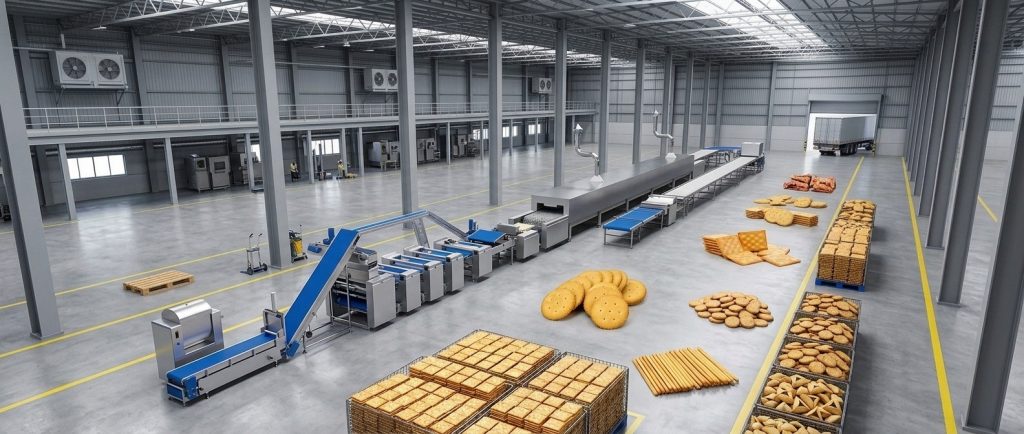
1. The 200 kg/h Tier: The Market Tester & Pilot Plant
- Who it’s for: Boutique local bakeries upgrading their operations, niche online brands, or large food corporations building an R&D pilot plant to test new recipes before mass production.
- The Engineering Reality: These lines typically utilize a narrow 400mm or 600mm baking belt. They require minimal floor space and run on lower utility requirements.
- The Pitfall: If a national supermarket chain suddenly lists your product, this line will max out instantly. Furthermore, the labor cost per biscuit remains relatively high because full automation (like automatic dough feeding or robotic packaging) is hard to justify on such a small scale.
2. The 500 kg/h Tier: The Golden Sweet Spot
- Who it’s for: Fast-growing startups aiming for regional B2B wholesale, or traditional bakeries ready to transition from semi-automatic to fully continuous industrial manufacturing.
- The Engineering Reality: We strongly recommend the 500kg/h biscuit line setup for serious startups. Mechanically, this is where true heavy-duty automation begins. It justifies multi-zone tunnel ovens for precise baking curves and handles continuous dough mixing flawlessly.
- The Advantage: It strikes the perfect balance. It drastically reduces manual labor while leaving enough mechanical headroom to absorb a 30-40% spike in seasonal orders simply by optimizing belt speeds and baking times.
3. The 1000+ kg/h Tier: The Aggressive Scaler
- Who it’s for: Joint ventures, well-funded FMCG (Fast-Moving Consumer Goods) investors, or startups launching with guaranteed mega-retailer/government tender contracts.
- The Warning: Do not buy this size just because you have the budget. A 1000+ kg/h line is a hungry beast. If you don’t have massive, consistent sales, running this line at half capacity will waste a tremendous amount of thermal energy. Your pneumatics and scrap return systems must run flawlessly—a 5-minute jam on a 1200mm belt means a massive amount of ruined product.
The Engineer’s Capacity Benchmark (New Neat Factory Data)
When calculating your production, remember that theoretical numbers on a brochure mean nothing without considering the baking surface area (Belt Width × Oven Length).
Furthermore, Hard Biscuits (like Crackers) and Soft Biscuits (like Butter Cookies) have entirely different baking physics. Hard biscuits are typically thinner and require a specific baking curve to extract moisture, meaning their total output by weight will always be lower than thicker, denser soft biscuits on the exact same line.
Disclaimer: The following table is based on standard New Neat factory commissioning data. Actual capacity will vary depending on your specific recipe, dough density, biscuit thickness, and precise baking time.
| Machine Model (Belt Width) | 40m Oven: Soft Biscuit Output | 40m Oven: Hard Biscuit Output | 60m Oven: Soft Biscuit Output | 60m Oven: Hard Biscuit Output | Target Buyer Profile (Best Suited For) |
|---|---|---|---|---|---|
| 600 mm | 500 kg/h | 300 kg/h | 750 kg/h | 450 kg/h | Ambitious Startups & Boutique Brands |
| 800 mm | ~ 660 kg/h | 400 kg/h | 1,000 kg/h | 600 kg/h | Regional Wholesalers & Mid-Sized Bakeries |
| 1000 mm | ~ 830 kg/h | 500 kg/h | 1,250 kg/h | 750 kg/h | Established Brands & Co-Packers (OEM) |
| 1200 mm | 1,000 kg/h | 600 kg/h | 1,500 kg/h | 900 kg/h | Large-Scale Industrial Production |
| 1500 mm | 1,250 kg/h | 750 kg/h | ~ 1,870 kg/h | ~ 1,120 kg/h | FMCG Corporations & Mega-Export Volumes |
(Engineering Tip: While 40m and 60m ovens are excellent starting points for widths up to 1000mm, for 1200mm and 1500mm wide lines, our engineers typically recommend extending the tunnel oven to 80m or 100m+ to maximize the thermal efficiency of the wide baking band.)
The Real Pain Point: Surviving Market Uncertainty
Here is the truth no machinery trader will tell you: The biggest risk for a startup isn’t choosing the wrong capacity today; it is being locked into rigid machinery when the market changes tomorrow.
What if you invest heavily in a hard biscuit line (soda crackers), but consumer trends shift toward soft butter cookies?
Startups don’t just need machinery; they need agility.
The New Neat Solution: Smart Scaling & The Overhead Bypass System
At New Neat, our engineering philosophy is built around future-proofing your investment. We specialize in modular bakery equipment custom designs specifically tailored for ambitious startups. We solve the “uncertainty problem” through two core engineering innovations:
Innovation A: Smart Phased Automation
In the engineering world, trying to “cut the oven belt and make it longer later” is a mechanical nightmare. Instead, we engineer for Downstream Scalability.
Here is the smartest way to invest: Purchase the core 500 kg/h forming and baking sections now. To save initial Capex (Capital Expenditure), utilize manual or semi-automatic packaging at the end of the cooling conveyor. However, our PLC architecture and conveyor chassis are pre-engineered with digital interfaces. When your volume explodes and your cash flow is strong, we seamlessly dock fully automatic grouping, sandwiching, and flow-wrapping modules to the end of your line. You lock in your baking capacity early, and scale your packaging automation only when it pays for itself.
Innovation B: The 3-in-1 Overhead Bypass Line
Most factories ask you to buy two separate lines for soft and hard biscuits. New Neat engineers an ingenious space-saving Hybrid Versatility System.
Here is how our mechanical routing works on the exact same baking band:
- The Layout: The Soft Biscuit machine (Rotary Moulder) is positioned closest to the oven, while the Hard Biscuit section (Laminator/Rotary Cutter) is positioned further upstream.
- Running Soft Biscuits: Soft dough is transported from the mixer via an overhead conveyor, literally flying above the hard biscuit section, dropping directly into the Rotary Moulder and then into the oven.
- Running Hard Crackers: The dough goes into the Laminator. When the continuous dough sheet passes through the Rotary Cutter, we use a quick-release tension mechanism. The transport web at the tail of the cutter is elevated to bypass over the top of the idle soft biscuit machine, feeding the hard biscuits directly into the oven.
- The Bonus (Sandwich Biscuits): We can configure the hard biscuit section with a Double-Layer Sheeter. This allows you to produce the high-quality base shells needed for sandwich biscuits.
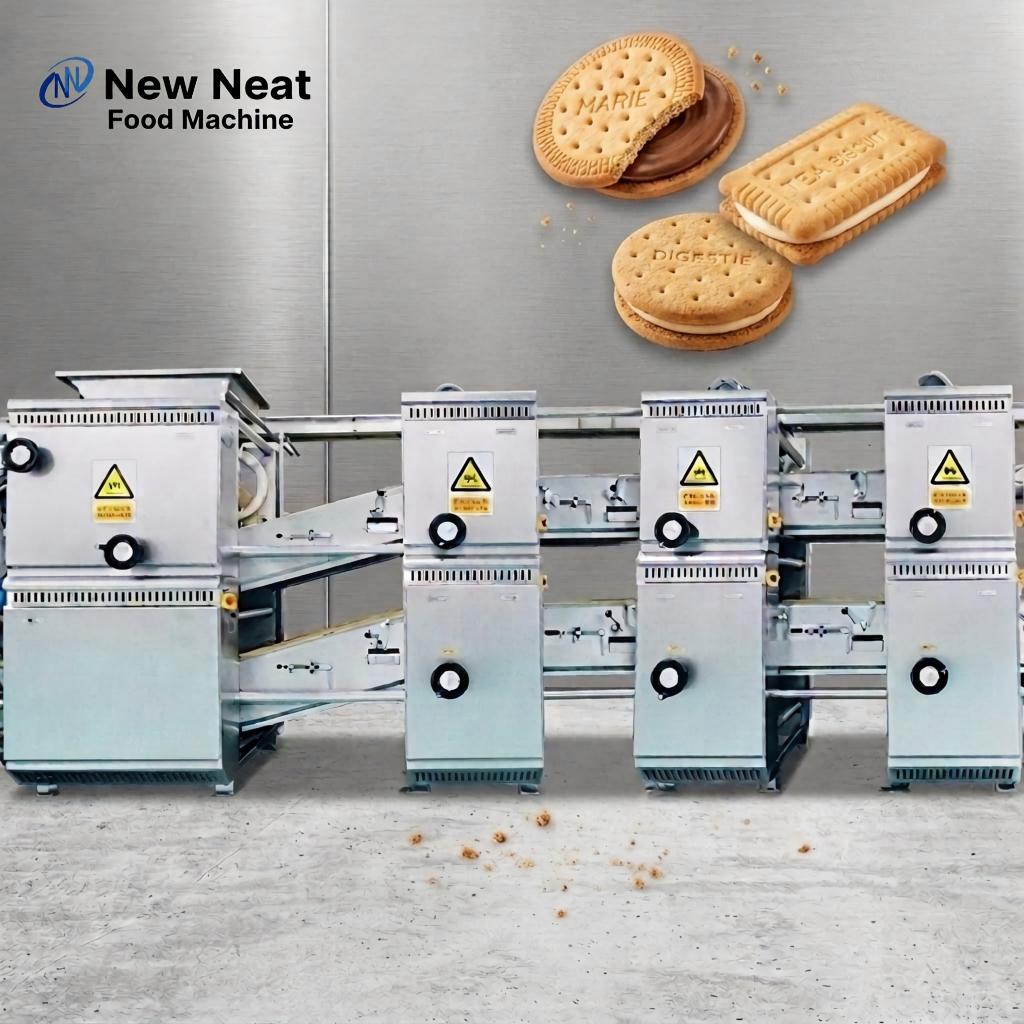
Why? Because it eliminates the need to buy a single-layer machine entirely. This dual-purpose powerhouse produces perfectly laminated standard hard biscuits (like soda crackers), AND it is the mandatory equipment for producing the precise top-and-bottom base shells required for premium Sandwich Biscuits.
The Result? With ONE initial capital investment, your startup is equipped to produce soft biscuits, hard biscuits, and premium sandwich biscuits.
Build Your Factory on a Solid Foundation
Choosing your capacity isn’t about picking a number on a brochure—it’s about choosing a Chief Engineer and a supply chain partner who can map out your mechanical growth.
Are you planning your first biscuit factory layout for startups? Stop guessing. Send me your target budget, available floor space, and a photo of the biscuit you want to make.
My name is Zhang, and the New Neat engineering team will provide you with a free, customized factory blueprint and a mechanical ROI assessment—ensuring your startup is profitable, and ready to scale.
[Contact New Neat Team for Your Free Layout Blueprint ->]