
By Engineer Wang from New Neat Machine
The most expensive mistake a food factory investor can make is ordering a biscuit machine based solely on a product photo.
In my 20 years of designing and commissioning biscuit production lines, I’ve seen countless buyers confuse Rotary Moulders with Rotary Cutters. Visually, the end products might look similar—a round, stamped biscuit. Mechanically, however, they require completely different forming principles based on one critical factor: Dough Rheology.
If you are planning to scale up your biscuit production, here is the engineer’s guide to choosing the right forming equipment, understanding dough mechanics, and maximizing your factory’s ROI.
1. It All Starts with the Dough: Soft vs. Hard
You cannot force a machine to process the wrong dough. The ratio of fat, sugar, and water completely dictates your equipment choice.
Soft Dough (Requires a Rotary Moulder)
Think of soft dough like wet sand. It has high fat and sugar content but very little water. Because it is mixed for a very short time, no gluten network is formed. It lacks elasticity and breaks easily if you try to stretch or roll it. Therefore, it cannot be sheeted; it must be pressed into a shape.
- Examples: Butter cookies, shortbread, digestive biscuits.

Hard Dough (Requires a Rotary Cutter)
Hard dough is leaner—lower in fat and sugar, but higher in water. Extensive mixing develops a strong, elastic gluten network. If you try to press it into a mold, it will shrink and deform as soon as you release it. Instead, this dough must be heavily sheeted, laminated, and then precisely cut.
- Examples: Soda crackers, Ritz-style crackers, animal crackers, hard sweet biscuits.

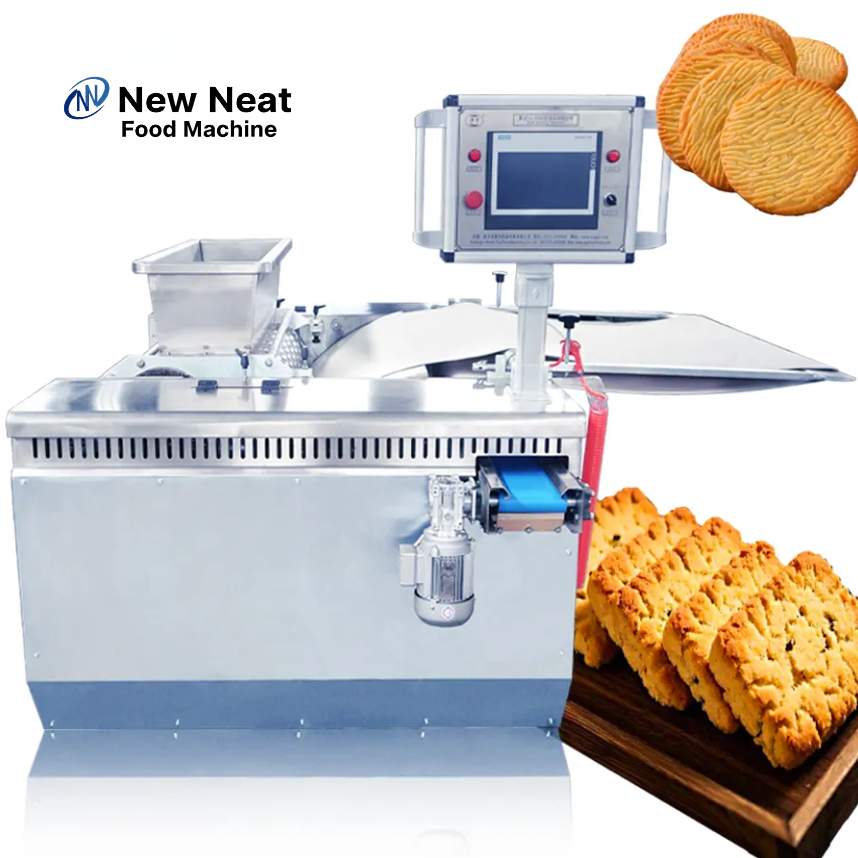
2. The Rotary Moulder: Master of Soft Biscuits
A Rotary Moulder works by forcing the crumbly soft dough into engraved mold cavities using a forcing roll. A rubber extraction roller, working in tandem with a canvas web, then pulls the formed biscuit out of the mold.
Engineering Highlights & Field Experience:
- Zero Scrap Dough: Because the dough is pressed precisely into the cavities, there is no leftover dough web. 100% of the dough goes straight into the oven, simplifying the line design.
- Custom Mold Materials: Sticking is the biggest enemy of a rotary moulder. Based on our field experience with different fat contents, we custom-machine our molds in two configurations:
- Solid Bronze: The traditional standard, offering excellent heat retention and smooth release for high-butter recipes.
- Iron Core with Food-Grade PC: A modern, lightweight alternative. Polycarbonate offers superior non-stick properties for specific sticky doughs and is highly resistant to industrial CIP (Clean-In-Place) chemicals.
- Pneumatic Web Cleaning: To prevent crumb buildup on the canvas during continuous 24/7 operation, our moulders feature an integrated Pneumatic Blow-off System that continuously clears the web, ensuring perfect biscuit release every time.
3. The Rotary Cutter: Precision for Hard Doughs & Crackers
Forming hard biscuits is a multi-step mechanical process. The elastic dough is first reduced into a continuous, paper-thin sheet (often ±0.15mm tolerance) using a series of Heavy-Duty Gauge Rolls. Once the sheet is prepped, it enters the Rotary Cutter station.
Engineering Highlights & Field Experience:
- Modular Single-Roll Design: Unlike rigid older machines, our rotary cutters utilize a modular design. The cutting process is handled by a precision Single Cutting Roller.
- Independent Embossing & Docking: Embossing (printing the logo) and Docking (poking holes in the dough) are handled by separate, independent components before the cutting roll. Why does this matter? Docking pins are critical to allow steam to escape during baking—preventing the crackers from blistering or exploding in the oven. Separating these components means you can change the cutter shape without replacing the expensive docking pins, saving massive tooling costs during recipe changeovers.
- Scrap Return System Management: Cutting round shapes from a continuous sheet leaves a “web” of scrap dough. Our PLC-controlled scrap return conveyors feature precise pneumatic tensioning. If the tension is too high, the delicate scrap web breaks; if too low, it jams. We ensure flawless synchronization to feed the scrap seamlessly back into the dough mixer or sheeter.
4. The Ultimate ROI: The Hybrid Production Line
What if your business strategy requires both butter cookies and soda crackers? You don’t need to buy two separate baking ovens.
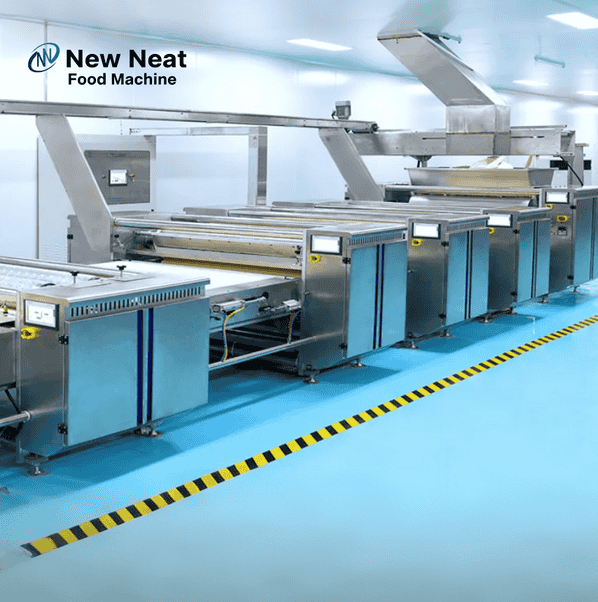
For clients looking to maximize product breadth, we engineer Hybrid Biscuit Production Lines. By extending the front-end layout, we install the Laminator, Gauge Rolls, and Rotary Cutter, followed immediately by a Rotary Moulder over the same oven feed-band.
When running hard biscuits, the Rotary Moulder is simply bypassed or lifted pneumatically. When running soft biscuits, the dough bypasses the sheeters and goes straight into the moulder. We have designed and successfully installed dozens of these dual-function layouts worldwide, like our recent 1200mm hybrid line project with 80 meters long tunnel oven in New Guinea, ensuring our clients achieve the highest possible return on floor space and capital investment.
5. Quick Decision Matrix
| Feature | Rotary Moulder (Soft Biscuits) | Rotary Cutter (Hard Biscuits / Crackers) |
|---|---|---|
| Dough Characteristics | High fat/sugar, crumbly, no gluten | Low fat, high water, strong gluten |
| Forming Method | Pressed into engraved molds | Sheeted flat, then cut by blades |
| Scrap Generation | Zero scrap. | Generates scrap web (requires return system). |
| Key Components | Forcing roll, Extraction web, Mold | Gauge rolls, Embossing/Docking units, Cutting roll |
| Line Footprint | Shorter (Dough goes directly to moulder) | Longer (Requires space for laminating & sheeting) |
Consult with Our Engineering Team Today
Choosing the right equipment dictates your product quality, scrap rate, and operational uptime for the next twenty years.
Don’t guess which machine you need. Send us a photo of your target biscuit, your recipe’s basic fat/water ratio, and your desired hourly capacity. Our engineering team will evaluate your product and provide a free, customized factory layout blueprint—whether you need a dedicated hard biscuit line, a soft cookie line, or a highly versatile hybrid system.
[Contact Our Engineers for a Free Production Layout Blueprint ->]