
Search
Search
Cutting Costs, Boosting Margins: How Energy-Efficient Biscuit Production Lines Pay Off
By New Neat New Energy Technology Co., Ltd. | Industrial Baking Insights
In the modern food manufacturing landscape, the challenge isn’t just selling more biscuits—it is producing them cost-effectively. With global energy prices fluctuating and raw material costs rising, the difference between a profitable factory and a struggling one often lies in the machinery itself.
For plant managers and factory owners, energy efficiency is no longer just a “green” buzzword; it is a financial survival strategy. At New Neat Machine, we engineer solutions that recognize a simple truth: The energy you save flows directly to your bottom line.
Here is how upgrading to energy-efficient biscuit production lines pays off.
1. Typical Energy Hogs in Biscuit Factories
To cut costs, you must first identify where the waste is happening. In a typical biscuit plant, the Tunnel Oven naturally consumes the majority (often 60-70%) of the total energy. However, older or poorly designed lines lose money through specific inefficiencies:
- Thermal Loss: Outdated ovens with poor insulation allow heat to bleed into the factory floor rather than baking the biscuit.
- Inefficient Combustion: Old gas burners often run on improper air-to-fuel ratios, wasting gas without generating optimal heat.
- Idle Energy: Conveyors and mixers that lack variable speed drives (VFDs) consume full power even when running at partial capacity.
2. The Tech Solutions: How We Fix It
Modern engineering turns these losses into savings. At New Neat New Energy Technology, we focus on three core areas to boost efficiency:
Advanced Tunnel Oven Insulation
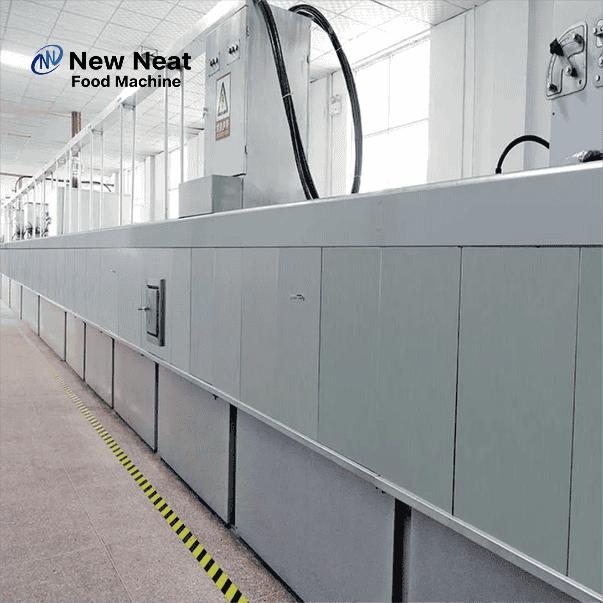
Our Tunnel Ovens utilize high-density insulation materials and hermetically sealed chambers. This ensures that the heat stays inside the baking tunnel.
- The Result: The oven reaches the target temperature faster and requires less fuel to maintain it.
Smart Control Systems (PLC)
Replacing manual controls with intelligent PLC systems ensures precision.
- The Benefit: If the line slows down, the oven automatically modulates the burner output. You never pay for heat you aren’t using.
Heat Recovery Systems (HRS)
Advanced lines can now capture waste heat from the oven exhaust and use it to pre-heat the combustion air or heat water for the mixing room. This is circular energy economy in action.
3. The Financial Case: ROI and TCO
When purchasing a Biscuit Production Line, buyers often look only at the “Sticker Price” (CAPEX).
However, the smart money looks at the Total Cost of Ownership (TCO).
The Repayment Calculation:
Imagine Machine A costs $100,000 but is inefficient.
Machine B (New Neat Efficient Model) costs $120,000 but cuts monthly gas bills by 20%.
If your gas bill is $10,000/month, Machine B saves you $2,000 every month.
In just 10 months, the extra cost of the better machine is paid off.
For the next 10 years of the machine’s life, that $2,000/month is pure profit added to your margins.
4. Beyond the Bill: Quality is Money
Efficiency has a secondary financial benefit: Consistency.
An energy-efficient oven maintains a stable baking profile. It does not suffer from temperature spikes that burn biscuits, nor drops that leave them undercooked.
- Less Scrap: Fewer rejected biscuits mean less wasted flour, sugar, and time.
- Better Product: Uniform color and moisture content lead to higher customer satisfaction.
Conclusion: Invest in Your Margins
In a low-margin industry like high-volume biscuit manufacturing, you cannot control the global price of wheat or gas. But you can control how efficiently your factory uses them.
Upgrading to an energy-efficient production line is an investment that creates a permanent reduction in your operating costs.
Is your current line eating into your profits? Contact New Neat Machine today to speak with our engineers about high-efficiency baking solutions tailored to your facility.